Sri Lanka has a lot of charming traditions that appeal to tourists as much as its lush landscape, thriving wildlife and vibrant culture. Of course, with modern conveniences, much of the island’s cultural heritage and traditional practices are slowly disappearing. One such iconic practice is stilt fishing. Once a thriving community, Sri Lanka’s stilt fishermen are now dwindling.
The art of stilt fishing is still alive in certain parts of the island, however, thanks in large part to captivating the imagination of visitors.
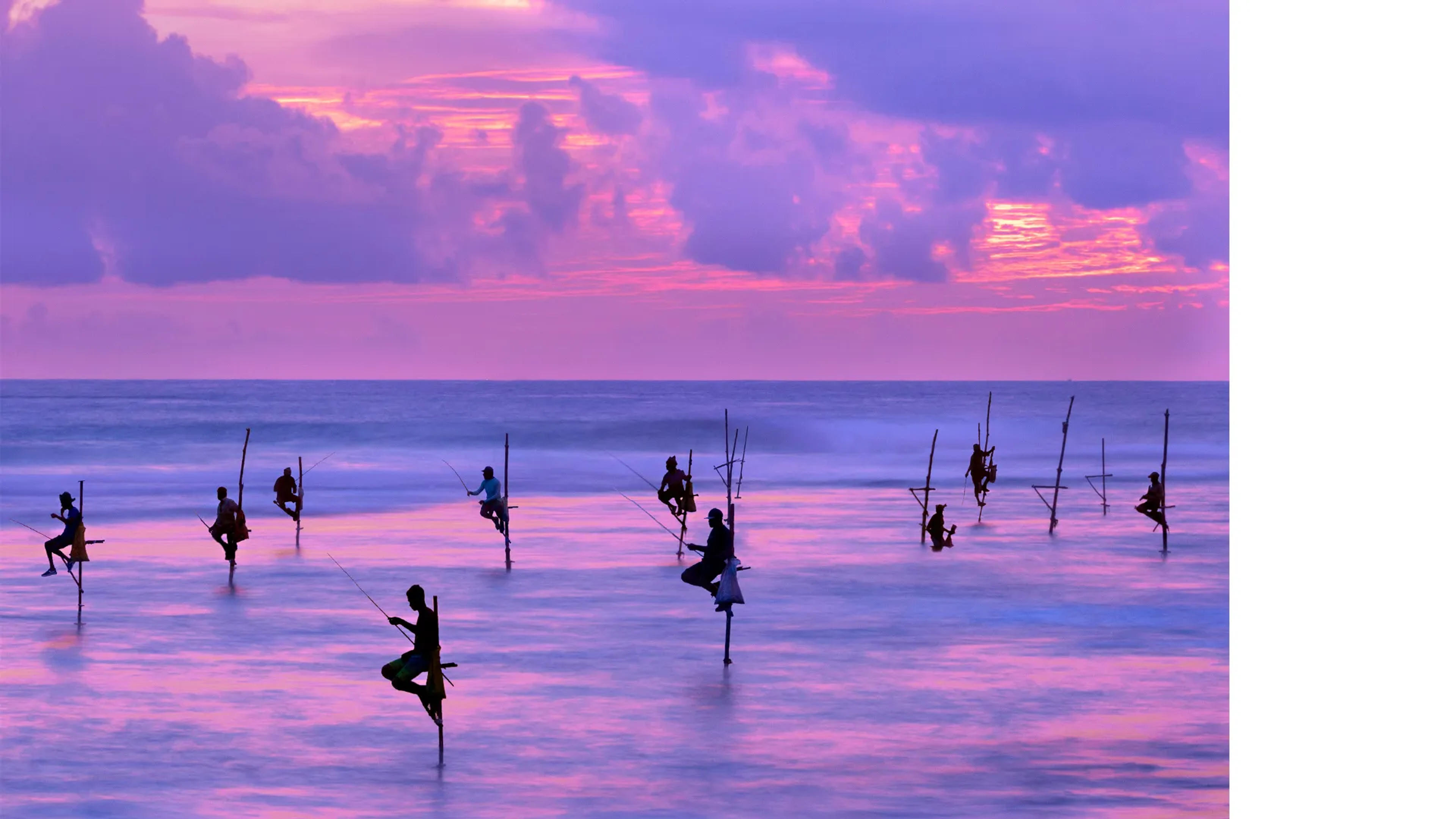
Image Credit: Getty Images
The history of stilt fishing in Sri Lanka
Sri Lanka is an island with traditions dating back centuries. So you would think that stilt fishing would also be old, wouldn’t you?
You would be wrong. It’s a surprisingly new(ish) practice, born during World War II. In short, it was a practice that came to life due to necessity.
Sri Lanka’s involvement in World War II may be a short line in the footnotes of history. But, it was a time that brought changes to the island. For one thing, the influx of British troops increased the demand for sustenance. That, in turn, affected the fishermen, as overfishing forced them to abandon their usual fishing spots.
Forced to get creative, fishermen began perching on unconventional spots within the waterline. Submerged rocks, sunk vessels and even the occasional downed aircraft.
The next wave of creativity came in the form of stilts. Fishermen could erect these poles directly on the coral reef. While balancing on the pole under the glare of the sun

demands patience, fortitude and endurance, generations of Sri Lanka’s stilt fishermen have carried the tradition forward.
The technique of stilt fishing

Image Credit: Getty Images
Stilt fishing is a delicate art.
The wooden stilt comes from Alstonia trees. Its length depends on the depth of the fishing spot, but usually, it’s about three to four metres long. Once the stilt is smoothed out, fishermen add ridges made of small wooden pieces to use as footholds. Cinnamon branches tied firmly to the stilt create a narrow platform where they can perch.
While the whole arrangement looks flimsy, it can hold the weight of a grown adult surprisingly well!
In order to erect the stilt, fishermen use a suitable place among the coral reefs. Or they can even erect it on the sandy sea bed, although it may not be as secure.
Sri Lanka’s stilt fishermen typically used homemade fishing poles. They would use white lead and steel wire to create the angle. The mould for the angle comes from the outer covering of a squid. Squids shed this covering – the dalipoththa, in Sinhala – as they grow larger. Fishermen would collect the hard shells as they wash ashore and etch grooves to create the mould.
Stilt fishing locations
Stilt fishing is no longer a widely practised art. This quaint and charming custom is now mainly seen on the southern coast, particularly around Galle, Unawatuna, Weligama and Koggala. It is somewhat appropriate, as these areas gave birth to the art.
However, it is difficult to name a specific beach where you can observe Sri Lanka’s stilt fishermen. You may be driving along the coast and observe poles sticking out of the sea, indicating their presence. But, even then, it may be difficult to see stilt fishermen in action. These fishermen are most active around early morning or evening.

Image Credit: Getty Images
The future of stilt fishing in Sri Lanka
Unfortunately, Sri Lanka’s stilt fishermen cannot sustain their families with the practice. Changing socio-economic backgrounds, and weather patterns are two of the major factors that stand in their way. It is difficult for fishermen who own ships to make a lucrative career out of deep-sea fishing. Stilt fishermen stand no chance. As a result, only the most dedicated fishermen would choose the practice as a full-time career. For most, it is a part-time or occasional activity. The 2004 Tsunami also wreaked havoc on the industry, forcing many to seek other livelihood avenues.
Another factor is the growing number of tourists. While tourist interest is saving the industry on one hand, their presence also disrupts stilt fishermen. The beaches where fishermen once plied their trade on stilts are now major tourist destinations. An active beach is not ideal for fishermen who depend on patience, silence and stillness.