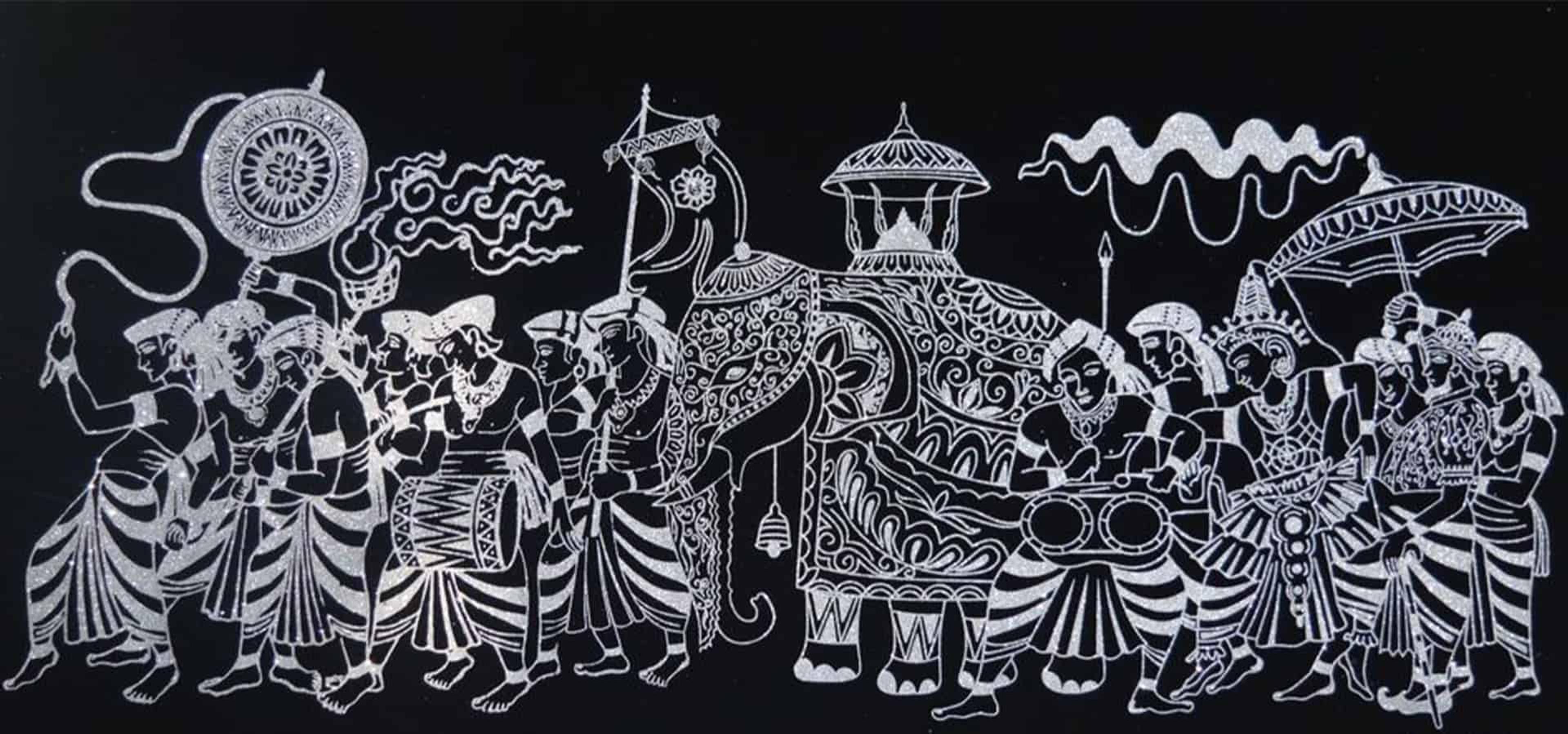
The night I went to see the Saman Devala Perahera (pageant) still ranks as one of the most memorable moments in my life. When you live in Sri Lanka, there is no shortage of colourful religious festivals all year round. In fact, some of these festivals are so beautiful that they go beyond being religious events. For instance, the annual Kandy Esala Perahera attracts hundreds of visitors from all over the world.
The beautiful cultural pageant in Kandy is perhaps the most famous of its kind in Sri Lanka. However, it is not the only perahera of note. In fact, there are other cultural pageants that draw huge crowds as well, such as the Kataragama Perahera. Among these events, the Saman Devala Perahera holds a significant place. Each year, the procession starts out from the doors of the Sumana Saman Devalaya in Ratnapura
The Devalaya contains many features that are common for Hindu kovils. However, it is primarily a Buddhist place of worship, honouring God Sumana Saman – a Buddhist guardian deity. The Devalaya has a centuries-long history, and the original structure is now long gone. Historians believe that the current building is the work of King Keerthi Sri Rajasinghe of Kandy.
Saman Devala Perahera at a glance
Saman Devala Perehera typically takes place in late August or early September. The event marks the Esala Poya (July full moon), and yet the dates are not firmly fixed in place. There are several days of events that herald the perahera. You know the beautiful cultural pageant is about to take place, as Ratnapura takes on a festive glow. On the days preceding the main event, there is a Pirith Ceremony, Kap Situveema, Kumbal Perahera, Dewale Perahera. These events take place across 13 days. And then comes the glamourous Maha Perahera.
Once the Maha Saman Devala Perahera finishes its route, there are still other events to follow. On the following day, the Devale officials hold a Diya Kapeema (water cutting) ceremony. The pageant comes to a final end with the Day Perahera, which is on a smaller scale but no less grand. All these events take place at an auspicious time. The Basnayake Nilame (the official in charge) oversees all the events to ensure that the event flows smoothly.
History of the cultural pageant
As with many traditional events of Sri Lanka, the Saman Devala Perahera also has a fascinating history. The history of the Saman Devalaya itself goes back to the reign of King Parakramabahu II of Dambadeniya. The King ruled from 1236-70, and Arya Kamadeva – one of his ministers – is responsible for building the Devalaya.
However, the Saman Devala Perahera began much later, during the Kotte Kingdom. The King at the time was Parakramabahu VI. Hiripitiya Nilame – the guardian of the Sacred Tooth Relic at the time, saw a dream where he was advised to take the Sacred Relic away from Kotte. The Nilame then replaced the Relic with an imitation and fled to Pepiliyana with the original Relic. A monk at the Pepiliyana Temple advised the Nilame to take the Sacred Tooth Relic to the Central Region to protect it from danger.
As a result, the Sacred Tooth Relic travelled to the Seethawaka Kingdom. King Rajasinghe, who ruled over the kingdom asked a monk from the Delgamuwa Viharaya to guard the Relic. However, to honour the Sacred Relic, the king held a perahera, which began at the Delgamuwa Viharaya and travelled to the Saman Devalaya. There, it joined the annual procession held each year at the Devalaya. To this day, the Dalada Perahera is a part of the Maha Saman Devala Perahera. In homage to its roots, a tusker bearing a symbolic Dalada Karanduwa (Golden casket that carries the Relic), is part of the Perahera.
What happens during the grand procession
The Maha Saman Devala Perahera comprise five separate processions.
- Dalada Perahera
- Paththini Perahera
- Biso Perahera
- Kumara Perahera
- Perahera dedicated to God Sumana Saman
Before the perahera leaves the Devalaya, the Basnayake Nilame places the golden casket atop the head of the Kapu Mahattaya – another official of the Devalaya. He, in turn, places it on the receptacle on the back of the tusker, and at the moment, a gunshot sounds out. The Thero in charge of Pirith observes the five precepts, and yet another gunshot signals to start of the Perahera.
The procession starts out with the above mentioned peraheras proceeding in that order. After the Dalada Perahera goes by, you can see the Maha Bamba Kolama. This is something unique about the Saman Devala Perahera, and the eight-foot-tall figure is commonly accepted to represent King Rajasinghe. The Maha Bamba has two faces and symbolises both the King’s kind nature and his will to punish those who act to harm others.
The Dalada Perahera is perhaps the most vibrant out of the five processions. Then comes the Paththini Perehera, held to honour Goddess Paththini. The Biso Perahera pays respect to the spouse of God Sumana Saman. After its wake comes the Kumara Perahera – representing the son of God Saman. The procession for God Sumana Saman follows behind, with the attendants carrying the ornaments of the deity. Last of all to come is the Basnayake Nilame and other office-bearers.
As the processions march through the streets, you can see dancers, musicians, flag bearers, torch holders, as well as numerous elephants. The sight of these gentle giants gently and daintily stepping in time to the drum beats is always a sight to behold. However, the main attraction of the Saman Devala Perahera is always the Tusker bearing the casket of the Sacred Relic.


